Choosing a peel-and-stick solar adhesive is not simply a matter of finding the strongest glue. The real challenge is matching adhesive performance with roof material, panel weight, temperature, moisture, and installation conditions. In our review of China’s top 10 peel-and-stick solar adhesives, we examine these factors through a practical lens. A product that bonds firmly to painted metal may perform poorly on aged PVC or dusty concrete.
As adhesive specialist Dr. Edward M. Petrie explains, “An adhesive is only as good as the surface it bonds to.” This principle guides the question, “How to choose the right adhesive for peel-and-stick solar?” Installers should check peel strength, shear resistance, UV stability, thermal cycling, and compatibility with the panel backing. Application temperature matters too. Some adhesives feel secure after ten minutes, yet need much longer to reach reliable holding strength.
Small details matter.
A clean surface is essential. So is controlled pressure.
This article compares adhesive types, curing behavior, weather resistance, and supplier documentation. It also considers real installation concerns, including uneven roofs, edge lifting, trapped air, and seasonal temperature changes. No adhesive is perfect. Even premium products may fail when preparation is rushed or the substrate is misunderstood. That is why our selection framework combines technical data with practical installation experience. Buyers can then compare Chinese manufacturers more fairly and choose a solution that supports long-term solar performance, rather than chasing the highest advertised bonding number.
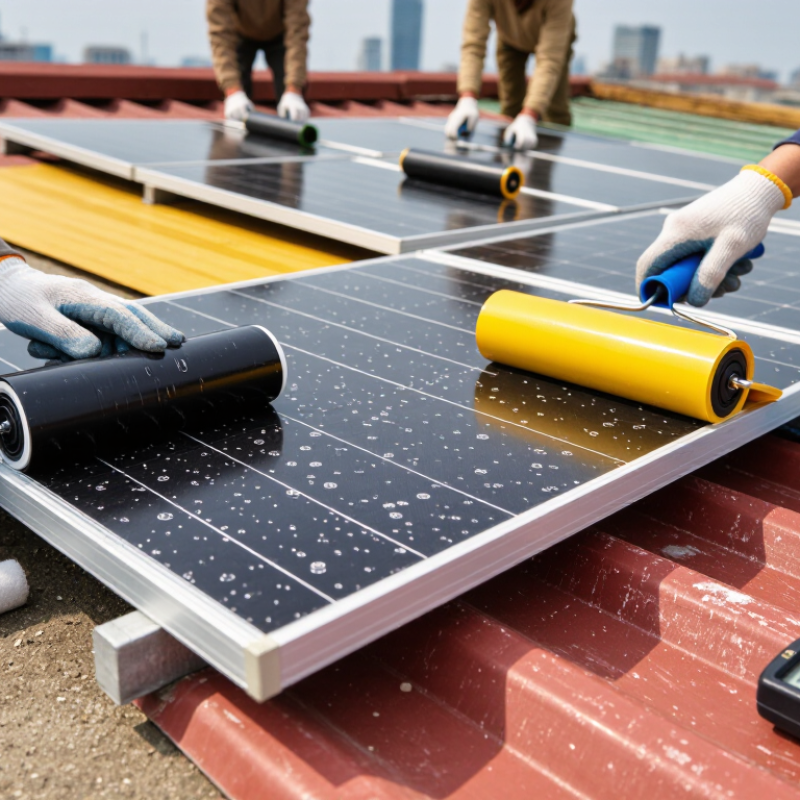
Peel-and-stick solar adhesives are pressure-sensitive bonding layers with a removable release liner. They attach solar components without liquid mixing or extended curing. Under IEC 61215, the adhesive is not automatically certified alone. Its influence on module durability must be assessed during design qualification.
IEC 61215 examines long-term performance through tests such as thermal cycling, damp heat, humidity-freeze exposure, and mechanical loading. The adhesive should maintain bonding after repeated temperature changes. It should not create bubbles, edge lifting, or moisture paths. Small failures matter. They can spread across a module.
IEC 61730 focuses on electrical and construction safety. A suitable adhesive may support insulation, creepage distances, fire behavior, and secure component placement. However, only complete module testing can confirm compliance. Ask for test reports, material traceability, thickness tolerance, peel strength, shear strength, and aging data. Check whether results represent the actual glass, backsheet, and operating temperature.
A peel test after one week is not enough. Review performance after heat, humidity, ultraviolet exposure, and thermal movement. Some suppliers provide impressive initial data but limited long-term evidence. That gap deserves careful questioning. Selection should match the module structure, installation method, climate, and repair requirements. Avoid treating a general adhesive certificate as proof of IEC conformity.
A reliable ranking should compare tested samples, not marketing claims. Rank 1 should deliver the highest peel strength after heat aging. Rank 2 may provide better shear strength under constant panel weight. Ranks 3 and 4 should resist creep during summer exposure. Ranks 5 and 6 may balance strong bonding with easier removal. Ranks 7 and 8 can suit lighter flexible modules. Ranks 9 and 10 may remain practical for sheltered installations. However, a higher ranking does not guarantee the best field result. Surface texture, dust, pressure, and installation temperature can change performance sharply.
Peel strength shows how firmly the adhesive resists lifting. Shear strength measures resistance to sliding, especially on vertical surfaces. UV resistance matters when sunlight reaches the adhesive edge for years. Look for test data after accelerated aging, not only initial values. A useful comparison includes stainless steel, coated aluminum, and solar backsheet surfaces. Testing at 23°C is helpful, but incomplete. Real roofs can exceed 70°C. Moisture and expansion create additional stress.
Tips: Clean the surface until no oily film remains. Apply firm pressure with a roller. Record temperature and curing time. Request peel, shear, and UV results from the same test method. I would also inspect an aged sample before purchase. Laboratory rankings can miss installation mistakes. That weakness deserves attention.
China Top 10 Peel and Stick Solar Adhesives: How to Choose?
For a China top-10 shortlist, compare acrylic chemistry before comparing price. Solvent-free acrylics usually offer cleaner processing and strong weather resistance. Modified acrylics may bond better to textured backsheets, but their aging behavior needs proof. IEA PVPS Task 13 reliability studies emphasize heat, humidity, and ultraviolet exposure as major photovoltaic stress factors. IEC 61215:2021 uses 85°C and 85% relative humidity for 1,000 hours in damp-heat testing. Ask suppliers for peel retention after similar exposure.
Backing material changes the result. PET provides dimensional stability and smooth handling. Nonwoven backings can improve conformability on uneven surfaces. Foam-backed products may fill gaps, but excessive thickness can increase thermal movement. I once compared initial peel only. That was a mistake. A high number can hide poor aging performance.
Use ASTM D3330/D3330M-22, or an agreed equivalent, and specify the test angle, peel speed, dwell time, and substrate. Many purchasing teams screen around 10–20 N/25 mm initially, but this is not a universal pass limit. More important is retention after heat, humidity, and UV testing. A product showing 16 N/25 mm initially and 13 N/25 mm after aging may be safer than one starting at 24 and falling to 7. Request lot-level data, not one attractive laboratory chart. Small details matter. Also inspect liner release, edge lifting, and application temperature.
The global photovoltaic market added about 456 GW in 2023, according to the IEA PVPS Trends 2024 report. More installations mean greater pressure on lightweight bonding systems. For peel and stick solar adhesives, request a complete 1,000-hour damp-heat report at 85°C and 85% relative humidity. Not just a certificate.
Check the tested construction carefully. It should match your actual backsheet, metal, glass, and coating combination. Ask for peel strength before and after exposure, cohesive failure records, and visible edge lifting. Test the bond. A strong initial peel value can hide moisture-driven failure. IEC 61215:2021 provides a recognized damp-heat framework for photovoltaic modules, but adhesive selection still needs product-specific evidence.
Review curing conditions, storage life, and application pressure. A factory trial should include dusty surfaces, curved panels, and temperature cycling after damp heat. IEA PVPS Task 13 reliability studies repeatedly emphasize that moisture, heat, and material interfaces influence long-term module degradation. The report matters.
I would not treat 1,000 hours as a lifetime guarantee. It is a screening milestone, not a crystal ball. Some suppliers provide beautiful graphs but limited raw data. That should make buyers cautious. Request laboratory accreditation, sample identification, failure photos, and test repeatability. Then compare the top ten candidates using the same substrate and peel-test method. Small differences become meaningful.
China Top 10 Peel and Stick Solar Adhesives: How to Choose?
When comparing China’s top ten peel and stick solar adhesives, start with the roof surface. Smooth metal needs strong initial grip and controlled movement. Aged asphalt shingles may require better conformity around raised granules. For concrete roofs, check compatibility, surface dust, and moisture levels. I have seen good adhesives fail because installers skipped simple surface cleaning.
Temperature matters during installation and service. A product applied below its minimum temperature may bond unevenly. Hot roofs can exceed 70°C under direct summer sunlight. Select an adhesive with a tested service range suited to local conditions. Allow for expansion and contraction. Small details matter.
Review the fire rating and request complete test documentation, not only a sales description. Confirm whether the rating covers the adhesive alone or the complete solar assembly. Warranty terms also need careful reading. Check coverage length, storage requirements, installation limits, removal costs, and whether labor is excluded. A ten-year warranty may offer less protection than expected. That deserves scrutiny. Keep batch records, photographs, and installation dates for future claims. A small sample test can reveal poor adhesion before a full roof installation.
The chart shows practical screening ranges for roof-surface service temperatures commonly encountered by peel-and-stick solar adhesive systems. These ranges are not universal adhesive ratings; confirm the adhesive supplier’s tested temperature range for the complete roof-and-module assembly.
When choosing an adhesive, first confirm roof compatibility, then select a service-temperature range that covers the local climate and roof surface. Require a tested roof fire classification such as UL 790 or ASTM E108 Class A, B, or C, and compare warranty terms for adhesion, weather exposure, replacement conditions, and installation requirements.
Compare solvent-free acrylic and modified acrylic formulations. Solvent-free options usually process more cleanly and resist weathering well. Modified acrylics may bond better to textured backsheets. Their aging performance still needs proof.
PET backings offer dimensional stability and smooth handling. Nonwoven backings conform better to uneven surfaces. Foam backings can fill gaps, but thick foam may increase thermal movement.
Initial screening often uses about 10–20 N/25 mm. This is not a universal pass limit. Test angle, peel speed, dwell time, and substrate must be agreed beforehand.
A high initial value can hide poor durability. For example, 16 N/25 mm falling to 13 after aging may outperform 24 falling to 7. I once compared initial peel only. That was a mistake.
Request testing at 85°C and 85% relative humidity for 1,000 hours. Ask for peel results before and after exposure. Request failure photos, sample identification, and repeatability data.
Yes. Test the real backsheet, metal, glass, and coating combination. Different interfaces can produce very different results. Test the bond.
Smooth metal requires strong grip and controlled movement. Aged asphalt surfaces need conformity around raised granules. Concrete requires checks for dust and moisture. Clean the surface carefully.
Check minimum application temperature, service temperature, fire-rating documentation, storage life, and required pressure. Review removal costs, labor exclusions, and installation limits. Keep batch records and photographs. A small trial helps.
Choosing among China’s top 10 peel-and-stick solar adhesives requires more than comparing initial tack. A reliable evaluation should define how each adhesive supports photovoltaic applications under IEC 61215 and IEC 61730, then compare peel strength, shear strength, UV resistance, acrylic chemistry, backing materials, and peel performance measured in N/25 mm. Particular attention should be given to verified damp-heat testing at 85°C and 85% relative humidity for 1,000 hours, as this helps reveal long-term resistance to moisture, heat, and bond degradation.
How to choose the right adhesive for peel-and-stick solar? Start by matching the adhesive to the roof surface, installation conditions, and expected service temperature. Check compatibility with metal, coated sheets, membranes, or composite panels, and confirm fire-rating requirements, outdoor durability, installation method, and warranty terms. The best option should provide balanced adhesion and shear stability without sacrificing flexibility, UV resistance, or maintainability. A structured comparison using documented laboratory data and clearly stated test methods can help buyers select a dependable adhesive for specific solar installation environments.

Sypower Solar